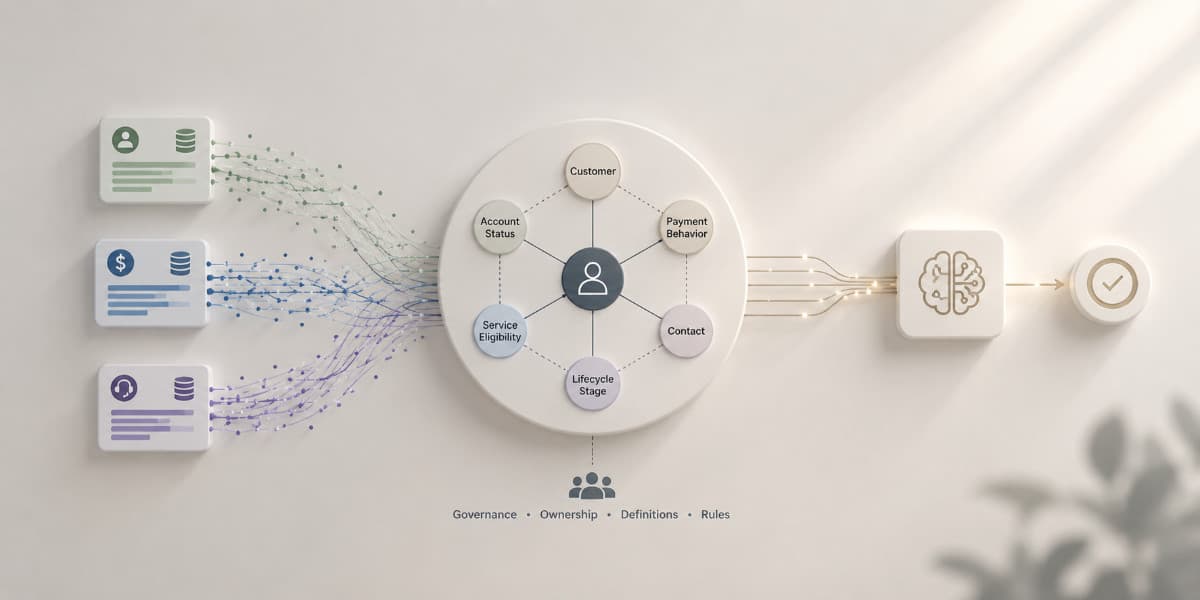
Ask a simple question inside a complicated organization: How many active customers do we have?
The customer relationship system produces one number. Billing produces another. The service team maintains a spreadsheet with a third. None is necessarily wrong. One counts anyone with an open account. Another counts only customers who paid within the last ninety days. The spreadsheet excludes accounts the service team considers inactive.
An AI assistant can retrieve all three, explain the differences, and produce a confident answer before the meeting begins.
What it cannot do is decide which definition the business is willing to operate on.
It cannot determine whether an unpaid account is still a customer or which department has authority to settle the definition. A model can choose an answer. It cannot make that answer legitimate.
This is why data readiness is not a prerequisite that sits before the AI project. Data readiness is the first and often most consequential part of the project itself.
When an organization has conflicting systems and no clear owner for the information connecting them, a larger model budget will not solve the problem. Before AI can act on the organization, the organization has to decide what is true.
The Demo Hides the Real Work
AI demonstrations are persuasive because they take place in a controlled environment.
The examples are selected. The documents are current. Someone has decided which fields matter and which records to ignore. The AI appears to understand the business because a team prepared the business for it.
Production removes that protection.
Real operations contain duplicate customers, missing dates, unofficial spreadsheets, outdated policies, and exceptions resolved from memory. Departments may use the same term differently. An authoritative-looking field may have stopped being maintained years ago.
The model is the most visible part of an AI initiative, but the organization's meaning lives in its data, operating rules, and people.
If those elements are not ready, the AI may still produce an impressive answer. The danger is that the answer will look more settled than the business behind it.
Dirty Data Is Often Decision Debt
Organizations tend to describe data problems as technical cleanup.
Records need to be standardized, systems integrated, duplicates removed, and missing fields completed. Those tasks matter, but they sit downstream of a harder problem.
Someone has to decide what the data means.
What makes a customer active? When does an opportunity become revenue? Which address controls service eligibility? When two systems disagree about an employee's status, which one governs access? Who may correct the record, and what evidence is required?
These are not database questions. They are operating decisions expressed through data.
When an organization avoids making them, ambiguity accumulates. Employees learn which report to trust for which meeting. Analysts keep private correction logic in saved queries. Interpreting the systems becomes dependent on informal knowledge held by a few experienced people.
AI does not remove that decision debt. It exposes it.
An assistant summarizing performance must choose among conflicting measures. An agent prioritizing accounts needs a definition of value. If leadership has not resolved those questions, the technical team must encode an answer without the authority to make the decision.
The resulting failure may look like an AI error. In reality, the system automated an ambiguity the organization had learned to work around manually.
AI Raises the Cost of Ambiguity
A disputed number in a monthly report creates an argument. A disputed number inside an automated workflow creates consequences.
The system may contact the wrong customer, deny a valid request, prioritize the wrong account, or use a policy that is no longer current. The faster the AI operates, the faster ambiguity moves from the database into the business.
This is the difference between data that supports analysis and data that supports action.
People compensate for weak data constantly. They remember that a policy changed, call a colleague, or check a second system before deciding. Much of that judgment is invisible because it happens inside the work.
An AI system needs those checks to be explicit. It must know when a source is authoritative, when two fields conflict, and when a person must take over. Otherwise, the organization has removed the people who knew where the decision could go wrong.
Every use case does not require perfect data. Its reliability must match the consequence of the action.
An internal assistant drafting a meeting summary can tolerate more uncertainty than an agent approving a refund. A tool suggesting duplicate records can operate with a lower threshold than one merging them automatically. Readiness is not an abstract maturity score. It asks whether specific information is trustworthy enough for a specific use.
Readiness Does Not Mean Cleaning Everything
The phrase "data readiness" can make an AI initiative sound like a multi-year transformation. That interpretation creates its own paralysis.
Organizations do not need to reconcile every record or replace every legacy system before producing value. They need a bounded workflow and the information it requires.
If the goal is invoice reconciliation, start with suppliers, purchase orders, receipts, approval rules, and the accounting definitions surrounding them. If the goal is to prioritize service requests, start with request history, customer status, service commitments, and escalation policy. Everything else can remain outside the first project.
The objective is not universal cleanliness. It is operational trust.
That trust may come from one authoritative system or a reconciled view across several. Two definitions can remain valid when they answer different business questions. What matters is that the distinction is intentional, documented, and available to the people and systems making decisions.
This creates a useful test. If the organization cannot agree on the information required for one valuable workflow, it is not ready to automate it. Discovering that before selecting a platform is not a delay. It is risk avoided.
Five Decisions That Make Data Ready
Before moving an AI use case into production, leadership should be able to answer five questions in plain language.
1. What business decision or workflow are we improving?
Begin without mentioning AI. Name the work, the people involved, and the outcome that should change.
"Use AI across finance" is not a workflow. "Reduce the time spent matching invoices to purchase orders while preserving approval controls" is specific enough to evaluate.
A bounded outcome determines which data matters and prevents a readiness effort from becoming an open-ended cleanup program.
2. What information must the system trust?
List the minimum information the workflow needs. Identify where each element originates, how current it must be, and whether the source is complete enough for the intended action.
This is a dependency map for the decision, not only a systems inventory. If the AI depends on a field employees rarely maintain, the project has identified an operating problem, not simply a missing integration.
3. Where do the sources and definitions disagree?
Do not hide disagreement behind a combined dashboard. Name it.
Which systems produce different answers? Which terms have competing definitions? Which exceptions rely on institutional memory? Which reports require manual adjustments?
The goal is not one universal definition. It is to decide which definition governs this workflow and preserve the information's origin so the answer can be traced.
4. Who owns the answer and the correction loop?
Technical teams can expose conflicts. They should not be expected to settle business policy on their own.
A named owner needs authority to define the operational truth, approve changes, resolve exceptions, and correct the process creating bad records. Specialists may support that owner, but responsibility cannot remain distributed across a committee.
Ownership also continues after launch. Data changes because the business changes. Without a correction loop, today's trusted dataset becomes tomorrow's undocumented exception.
5. When may the AI act, and when must a person decide?
Define the boundary before the system encounters it in production.
What confidence is sufficient? Which sources may the AI access? Which actions require approval? What happens when records conflict? Can an action be reversed? Who reviews mistakes, and how does that review improve the system?
Human review should not be a vague promise added at the end. Design it around the moments where the data cannot support a responsible automated decision.
The Readiness Work Pays Off Even If the AI Changes
A disciplined readiness effort produces value before the first model reaches production.
Leadership gains clearer definitions. Reports become easier to reconcile. Employees spend less time checking unofficial sources. The organization learns which processes create unreliable information and which decisions depend on undocumented judgment.
The work may also reveal that AI is not the first intervention the business needs.
Sometimes the right first step is an integration, a policy decision, a simpler form, or the removal of an unnecessary process. A narrow rules-based workflow may outperform AI. The expected value may not justify resolving the data problem yet.
Those are successful outcomes because the purpose is not to justify an AI purchase. It is to identify the shortest responsible path to a business result.
This separates the work from a generic data assessment. The question is not whether the organization has achieved ideal data maturity. It is whether a defined workflow has the information, ownership, controls, and operating discipline required to improve safely.
Start Where the Systems Disagree
AI initiatives are often presented as technology selections: which model, which platform, which vendor, which architecture.
Those choices matter, but they come after a more fundamental decision. The organization must establish what the system is expected to know and who stands behind that knowledge.
When three systems produce three versions of the customer, AI does not create a source of truth. It scales the disagreement. When a policy exists only in an employee's memory, an agent cannot apply it consistently. When nobody owns the correction process, data quality becomes a recurring project instead of an operating responsibility.
The actual AI project begins at that point.
It begins by choosing a valuable workflow, identifying the information it needs, resolving the definitions that matter, and assigning an owner who can keep them true. The model comes later, once the organization has something reliable to give it.
Before asking whether your organization is ready for AI, ask a more useful question: Is it ready to decide what the AI is allowed to believe?
If your organization is evaluating an AI initiative, Honra can help you identify the workflow worth preparing and build a practical data-readiness plan around it.
Honra is an independent technology advisory firm based in San Juan, Puerto Rico. We provide fractional CTO and CIO services, strategy, owner's representation, and implementation across software, data, and AI. Start an engagement.